
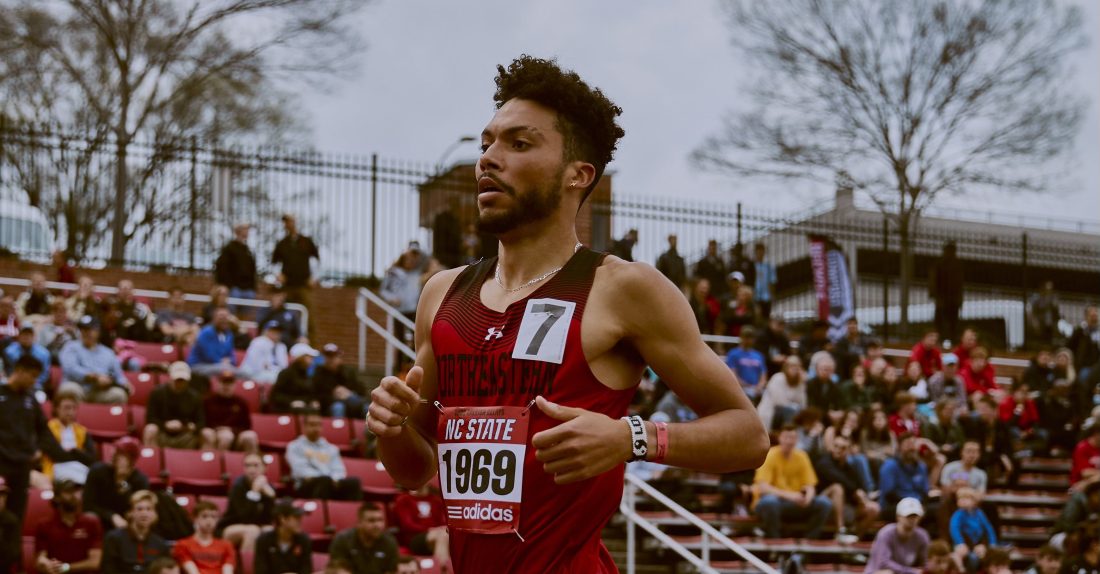
Following a heartbreaking finish at the 2021 NCAA Outdoor Track & Field Nationals, Alex Korczynski describes his path to overcome his frustration and return to once again compete on the big stage.
Written by Alex Korczynski. Photo courtesy of Joe Hale.
Head in my hands, towel over my head, and no way to tell the difference between rain and tears on my face, this was both the pinnacle and the lowest point of my career. My legs were still trembling with adrenaline and my hands and feet were still numb from the impact. Accepting the reality of what just occurred felt nearly impossible.
2021 NCAA Outdoor Track & Field Nationals, the largest stage of competition I’ve ever competed in. The classic afternoon in Eugene, Oregon came with mid-sixty-degree weather and a violent downpour of rain. The race I was running was the 3,000-meter steeplechase, nearly two miles (3,216m) of racing while jumping over 28, 36-inch-high ground barriers and seven water barriers throughout the race. The steeplechase requires the strength of a miler and a 5k runner along with coordination and grit to finish. Pouring rain isn’t the ideal weather considering you need to firmly plant and push off objects numerous times. In tandem with a fast pace and fatigue, the environment is a challenging one to overcome.
National-level races are unique in that not only are all the opponents good physically, but they’ve consistently done well in tactical races full of solid competitors. Even if a runner has the potential to move on, only those who perform the best on the day advance. I was seeded in the second heat of 12 in the steeplechase for the semifinal. Only the top five of each heat and the next two fastest overall advance. To my advantage, I knew that the slowest times making the final were 8:32.9 so far. This rang some alarms. My record at the time was a mere 8:44 from the regional meet, I had to be prepared to run well under my best time to ensure I made the final. Couldn’t be a better time than being in the best shape of my life, right?
After warming up under Oregon’s mystical Hayward Field Stadium, all of us heat-two athletes were brought out through a tunnel onto the track. After a couple of minutes, we’re lined up on the starting line and ready to go off. Ironically, someone in the stands yells that we should postpone the race with the amount of rain coming down (the first heat barely escaped it). Inside I laughed because they would never do such a thing, not with a TV window. I agreed with the fan considering I had never run a steeplechase in the rain, but I had never fallen in a race before either, so the fear was negligent. Within minutes the, “On your marks,” cue came. I readied onto the line, my heart pounding, and my head clear. The gun blasted.
I’m the first out the gate from the moment the gun goes off. As expected, the atmosphere was like no other. Hayward Field is shaped like a giant U, having full stands surrounding most of the track while fans constantly clap in unison and cheer abundantly.
Most runners would agree it isn’t best to lead an entire race because wind can hinder your performance. Racing the steeplechase can be weird compared to other events. Running in front grants a visual advantage for seeing the barriers, which is how I executed my regionals race two weeks prior.
The laps keep ticking off, the wind is minimal, and I’m still leading. I start to reach the hard part of the race around halfway and at a pace faster than what I’ve hit before. Instead of letting others overtake me as they had at regionals, I decided to put mental pressure on my opponents and push the pace to make them struggle more to pass me.
As the race unfolded, one by one talented runners were fading from the front pack. 2,400 meters into the race there were only seven runners in the front pack, other runners started to go around me. As I fell back to around fifth, I was in immense pain but comfortable with others leading for a little. Lap splits from the regional races indicated I possessed one of the fastest finishing laps of all athletes in the field, I just had to replicate success at a harder pace to secure a top-five finish.
The final lap bell rings as the crowd continues to roar. Passing through the line with 400m to go and I began my move. Within 150m I’m leading again, moving at a faster pace than the rest with numb limbs and an overriding mind. Approaching the last water barrier, my legs are turning over rapidly as I plant my foot, but something is off. My front leg slips, my back leg clips the barrier and I go flying over the water crashing onto the track, athletes flying over me.
The energy it took to get up was crippling. Once you hit a full stop at such high effort, all the lactic acid starts to hit, and the pain settles in. I knew immediately when I fell that I was out of qualifying for the final as the others were too close behind. I finished the race, pity claps in tow, and I just bent over in disbelief. Unlike a normal finish at Hayward Field, the crowd was nearly mute. In frustration, sadness, and anger I slapped my thighs, leaving clear handprints. With the rest of the field, I was guided off the track, soaking wet to the cooldown tent. The result was tenth in my heat, 22nd overall, and honorable mention for All-American status.
I don’t regret anything about how I executed my race, and in turn, I was proud of it. Regardless, nothing could sting more than doing everything perfectly on the day of my career that mattered most and slipping over one of the last few barriers. After all, I ran on pace to run 8:34, a ten-second improvement from my previous best in bad weather after barely scraping through my region. Sometimes it’s comical to try and count the number of people watching that I made cry at one instance of time.
Track & Field is a cutthroat sport. To become a professional, a runner needs to place within the top few spots in the NCAA final, and I had just missed out on my first opportunity due to a small mishap.
Fast forward 11 months to outdoor season the next year. The preceding cross country season had gone decent overall, missing the first meet with COVID-19 I eventually missed qualifying for the NCAA XC championships by five spots which was a disappointment, yet an improvement from the year prior. The following indoor season had gone well. Running 4:00.5 in the mile, I was set up to do well in the outdoor season.
In hindsight, I think I acquired some degree of PTSD. On the team’s first outdoor travel meet coach Lonergan had me get some water jumps in for practice and within steps of approaching the barrier, my heart rate spiked from 90 bpm to 150 bpm. Despite the newly introduced fear, the jumps went well. After a couple of steeplechase races, I secured a spot at the regional competition.
With an 8:48 season’s best, I wasn’t seeded to get through the top 12 but I stayed confident and trusted my experience and fitness and finished third in my heat (the top three of each heat plus the next three fastest overall advance). The tactical 8:39 personal record got me seventh out of 48 overall to secure another national bid. The cherry on top was that it happened to be a rainy day.
In contrast to the 2021 outdoor season, the 2022 NCAA semifinal race day came with great weather. 64 degrees and sunny. Training had gone great, and I felt like I had all the components I needed to contend for a win in the final, I just needed to get through my semi.
Once again, the race started at a spicy tempo. I didn’t have much of a game plan as I knew I had the finishing speed, I just needed to make it to the final 1000m or 600m and I could push myself to close. In a true coincidence, getting there was the issue.
Like most sports, and especially in track & field, you don’t always know how you’re going to feel in a race beforehand, and in that semifinal, I didn’t feel great. After two laps, I was already struggling to keep pace with the pack, and almost every 200m I had to make an extra effort to close the gap between myself and the leaders as losing that margin makes contending for the win significantly harder. At around 1800m, I started to fall off the front pack, and from there I faded to finishing ninth in my heat and 15th overall for Second Team All-American Status.
Again, it felt like I had failed when the time came for me to perform my best. I ran 8:43, just a couple seconds off my record from a few weeks prior but I know I’m capable of much faster. The time that won my heat was 8:26, four seconds off the 8:22 steeple standard to compete at the world championships, and well under the 8:29 US championship standard. In the final, my competitors went on to run 8:18 and later competed at the World Championships. While I was fit and ready, maybe my flaw was preparing to race ‘college athletes’ when I was racing some of the best in the world.
Through the fog of triumph and despair, I could still see the progress I had made. I raced myself through to the NCAA championships a second time and performed better after feeling defeated in 2021. The redemption tour didn’t exactly go as planned, but it was somewhat of a success.
Today, I’m battling an ankle tendinitis injury that has been tremendously irritable. In my last year at Northeastern, I wanted to qualify for nationals every season and do well on that stage. In the fall of 2022, I qualified and ran at cross country nationals, which given my strengths, should be the hardest of the three seasons for me to achieve. Before I could get to the indoor season, I picked up ankle tendinitis and tenosynovitis which has taken me out for the remainder of the indoor and outdoor season. To be at my peak and reach rock bottom again is testing, but as long as I keep making strides forward, I’ll be back. After an honorable mention finish in 2021, a second-team finish in 2022, and a season of indoor and outdoor eligibility left, there’s nothing less for me to see through than make it to the NCAA final and claim the title of national champion. Since I’m training to race some of the best in the world, Olympic training starts now.
 The Red & Black